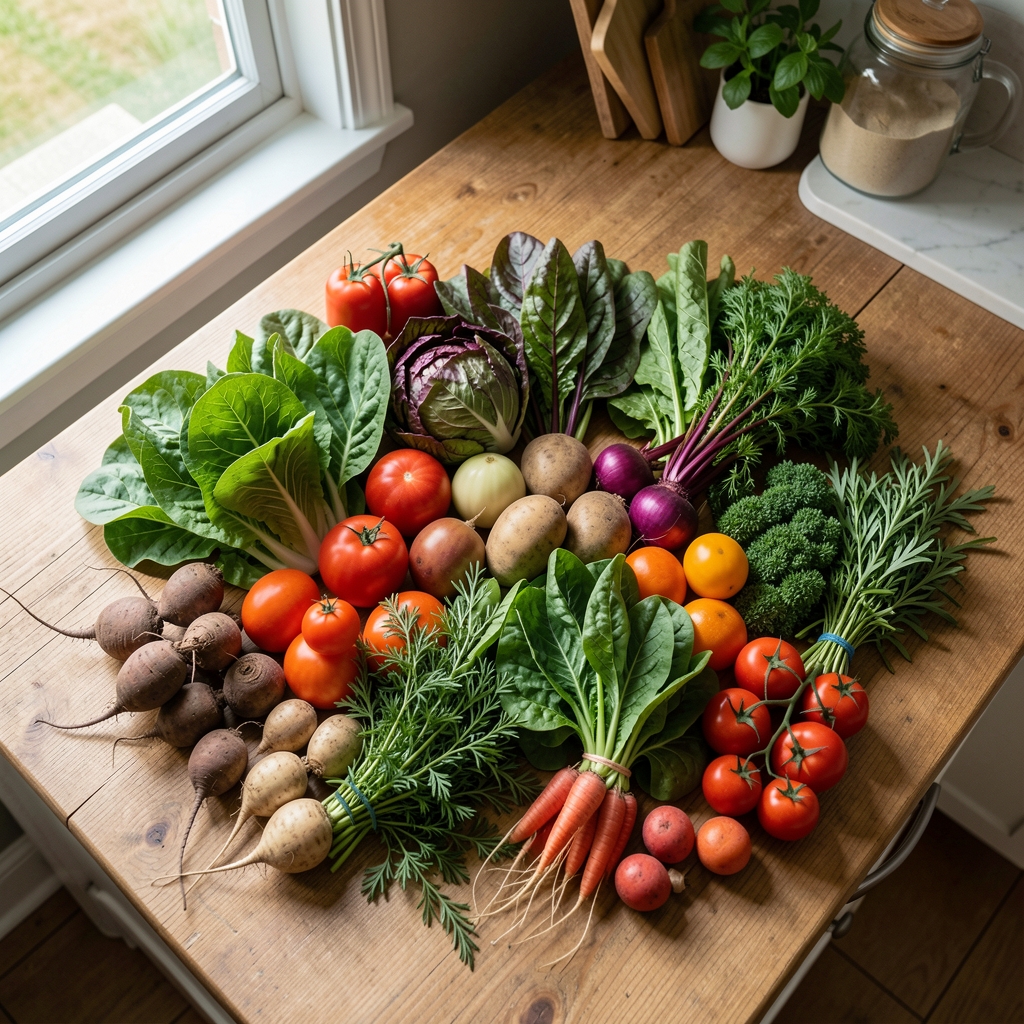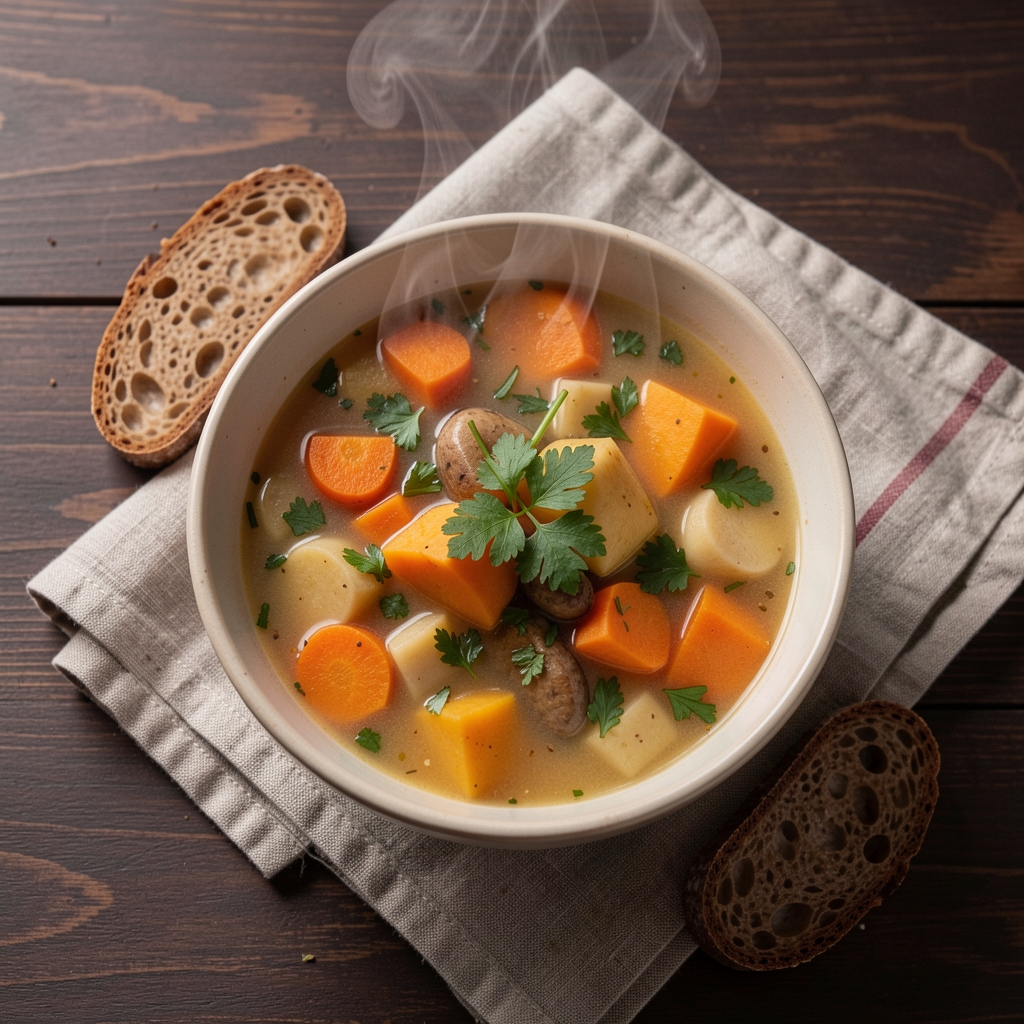
Across the four seasons, the composition of available produce shifts substantially — from spring's tender legumes and leafy greens, through summer's high-water-content fruits, into autumn's dense root vegetables and winter's fibrous brassicas. Each transition carries nutritional implications that a fixed meal-planning framework tends to overlook. Aligning kitchen habits with these natural cycles offers a straightforward method for maintaining dietary variety without requiring elaborate supplementary strategies or nutritional databases.
The Fibre Variable: Why Seasonal Variety Matters
Published dietary guidelines in the United Kingdom consistently identify inadequate dietary fibre as a widespread pattern, with the average adult consuming roughly 18 grams daily against a reference intake of 30 grams. The gap is well-documented. Less examined, however, is the qualitative dimension: not all fibre behaves identically within the digestive tract. Soluble fibre — abundant in oats, apples, and legumes — forms a gel-like consistency during digestion, slowing glucose absorption and contributing to satiety signals. Insoluble fibre, found in wheat bran, whole grains, and many root vegetables, adds bulk and supports regularity.
A seasonal approach to meal planning naturally introduces both fibre types across the year. Spring peas and broad beans supply soluble varieties; autumn's parsnips, swede, and leeks contribute insoluble bulk. The rotation is neither calculated nor effortful — it emerges from purchasing what is available, fresh, and at peak composition from the current market or seasonal supplier.
Nutritional research notes that gut microbial populations respond to changes in dietary substrate over periods as short as a few days. A consistently varied fibre profile — achieved through seasonal rotation — provides a broader range of substrates than a fixed weekly menu built around year-round staples alone. This is a structural advantage that requires no supplementary products and imposes no additional complexity on the weekly kitchen routine.
Spring and Summer: Volume, Colour, and Hydration
The spring and summer months bring produce with high water content: cucumber (96% water by mass), courgette (94%), tomatoes (94%), strawberries (91%), and watermelon (92%). These figures, drawn from standard food composition tables, are relevant to hydration habits. While drinking water remains the primary hydration source, food-derived water contributes meaningfully to daily fluid intake, particularly in warm months when perspiration losses increase.
Spring legumes — broad beans, garden peas, mange tout — provide protein alongside fibre, a combination that supports satiety in a balanced meal context. Their availability is brief, typically six to eight weeks at peak freshness in the UK. A well-organised kitchen routine accounts for this window: buying in quantity, blanching, and freezing preserves the nutritional profile while extending access beyond the market season without significant loss of compositional value.
The colour diversity of summer produce is not merely aesthetic. Red and orange pigments in tomatoes, peppers, and carrots derive from carotenoid compounds, including beta-carotene and lycopene. Deep greens in courgette skin, spinach, and rocket indicate concentrations of chlorophyll alongside iron and folate. A plate assembled with colour as an informal guide tends toward broader micronutrient coverage than a monochromatic arrangement, without requiring nutritional analysis.
"A plate assembled with colour as an informal guide tends toward broader micronutrient coverage than a monochromatic arrangement — this is seasonal eating's most practical compositional advantage."
Autumn: Density, Storage Roots, and Slow Cooking
Autumn marks a transition in cooking method as much as ingredient choice. The arrival of dense root vegetables — celeriac, parsnip, beetroot, swede, butternut squash — favours longer preparation times: roasting, slow-braising, and soup-making. These methods alter the physical structure of fibrous cell walls, rendering nutrients more accessible while producing Maillard reaction products that contribute to flavour depth.
Butternut squash deserves specific note for its beta-carotene density — approximately 4,226 micrograms per 100 grams when cooked. Combined with a small amount of dietary fat, such as olive oil used in roasting, fat-soluble carotenoid absorption is substantially enhanced. This is a practical illustration of how preparation method and ingredient pairing interact within the same meal to affect nutritional availability.
Pulses — dried lentils, chickpeas, cannellini beans — represent a year-round staple that integrates seamlessly into autumn cooking. Their contribution to both protein and soluble fibre per 100 grams (roughly 8–9 grams protein, 5–7 grams fibre in cooked form) places them among the most nutritionally efficient home-cooking ingredients by cost and preparation simplicity. A large batch of cooked lentils or chickpeas prepared on a Sunday afternoon provides the foundation for four or five weekday meals.
Winter: Brassicas, Fermentation, and Gut Substrate
Winter produce in the UK is dominated by brassicas: Savoy cabbage, kale, Brussels sprouts, purple sprouting broccoli, and cauliflower. This family of vegetables contains glucosinolates — sulphur-containing compounds that, upon chopping or chewing, convert to isothiocyanates. Published nutritional research has investigated these compounds' interactions with gut microbial populations, noting their role as substrates for specific bacterial communities present in the lower digestive tract.
Fermented foods — yoghurt, kefir, sauerkraut, kimchi, and live-culture cheeses — represent a practical winter addition for those seeking to diversify dietary inputs. These products introduce live microorganisms into the digestive environment. Their practical integration into a weekly menu requires little preparation: adding two tablespoons of live yoghurt to a morning bowl, or incorporating a spoonful of sauerkraut alongside a winter grain salad, represents a low-effort addition with compositional relevance.
Prebiotic fibres — found in garlic, onion, leek, and Jerusalem artichoke — act as substrate for established gut microbial populations. These ingredients are largely available year-round but appear most prominently in winter recipes: long-cooked broths, braised leek dishes, and roasted root vegetable compositions. Their regular inclusion in the weekly cooking rotation contributes to consistent prebiotic substrate availability without requiring deliberate supplementary strategy or specialist ingredients.
- 01 Seasonal produce rotation naturally diversifies both soluble and insoluble fibre types without deliberate planning effort.
- 02 Colour variety on the plate serves as an informal proxy for micronutrient breadth — particularly for carotenoids and folate.
- 03 Cooking method interacts with ingredient selection: fat-soluble nutrients require dietary fat for effective absorption.
- 04 Winter fermented foods and prebiotic-rich alliums provide consistent gut substrate across the lower-produce months.
- 05 Blanching and freezing peak-season legumes extends nutritional access without requiring complex preservation methods.
Practical Notes on Meal Construction
The editorial team at Talrun Journal has observed, across multiple issues, that the most consistently nourishing home-cooking approaches share a structural logic rather than a rigid recipe format. A useful template for the evening meal: one dense starchy component (whole grain, legume, or root vegetable), one or two additional vegetables representing different colour groups, a protein source (plant or animal depending on preference), and a fat component that doubles as a flavour carrier.
This template accommodates seasonal substitution fluidly. In June, the starchy component might be new potatoes; in October, roasted butternut squash. The protein source — poached eggs, grilled salmon, white beans — shifts according to what the weekly shop yields. The structural logic remains constant; the ingredients rotate with the calendar. This is the practical expression of seasonal alignment in an everyday kitchen.
Meal planning documents — maintained as a weekly list rather than a formal schedule — assist in translating seasonal awareness into practical shopping decisions. Noting what was purchased the previous week and what remained unused helps calibrate portion quantities over time. A food journal, even one maintained only for four-week periods, provides useful pattern data about personal consumption rhythms that a fixed recipe plan cannot surface.
A Note on Seasonality and Food Sourcing
Seasonal eating in the UK context does not require access to a farmers' market or specialist greengrocer, though both improve the quality and variety of produce available. Major supermarkets now commonly label seasonal UK produce, and their seasonal ranges shift meaningfully across the year. The practical requirement is attentiveness during the weekly shop: observing what is prominently stocked and at competitive price points typically correlates with what is in-season and at peak compositional quality.
Imported produce supplements rather than replaces seasonal variety. Bananas, citrus fruits, and avocados are nutritionally valuable and available year-round, but the nutritional contribution they make is complementary to, rather than substitutive for, the locally seasonal items that change with each quarter. A kitchen that holds both in its weekly repertoire maintains broader compositional coverage than one that relies exclusively on either.
The seasonal cooking approach documented here is not an ideological position but a practical observation: aligning procurement and preparation habits with the natural agricultural calendar produces greater dietary variety as a structural outcome, requires no specialist knowledge, and tends to reduce food cost through the seasonal pricing of peak-supply produce. These three factors — variety, accessibility, and economy — represent a coherent practical case for seasonal cooking as a foundation for everyday nutrition.